Claude Opus 5.5 vs Opus 5: I Ran the Same Tests. Here Are the Receipts.
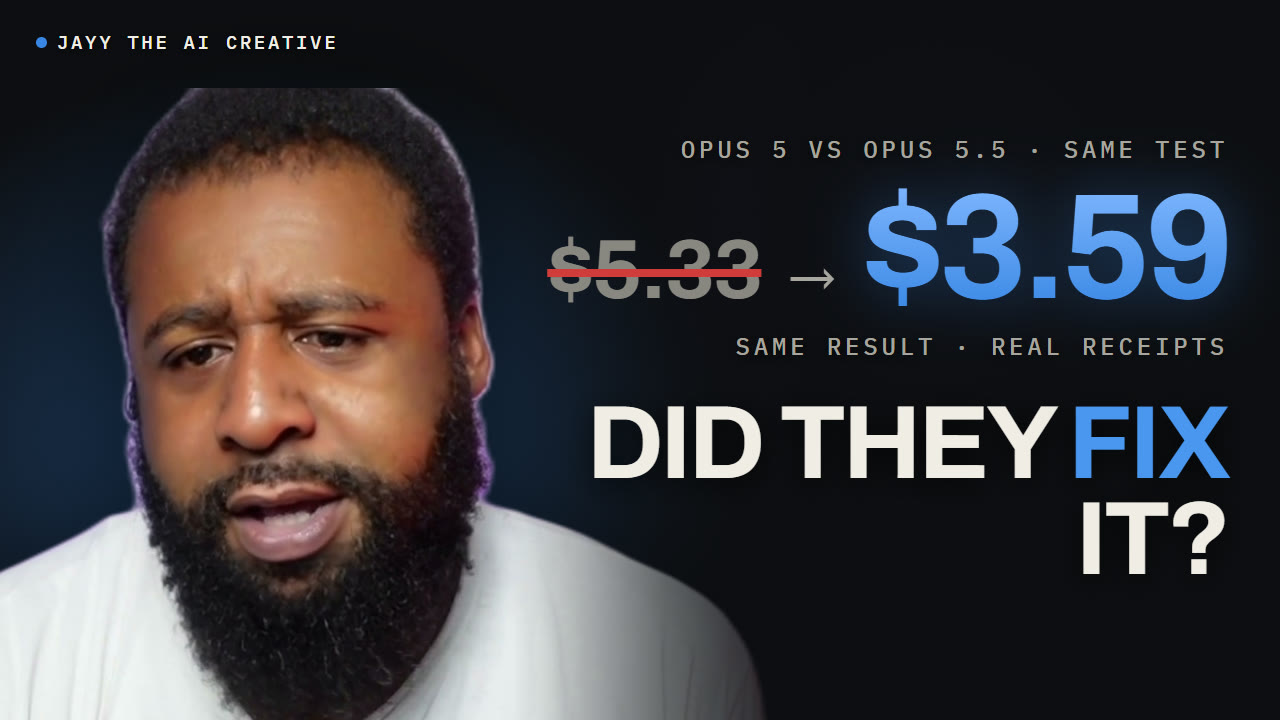
Watch the companion video: Claude Opus 5.5 vs Opus 5: Same Tests, Real Receipts. This post has every number and source from the video.
Free test kit: the three prompts, both models' outputs, the cost receipts and the scoring rubrics are in the Claude Opus 5.5 Test Kit. No sign-up.
A few weeks ago, the loudest thing people said about Claude Opus 5 was that it was lazy: walls of text, half-finished work. Then Anthropic shipped Opus 5.5 and said it performs like Fable 5.1 on most work, costs 40% less to run than Opus 5, and writes its output more than 30% faster.
I covered the launch numbers in 7 ways creators can use Opus 5.5. This post is the follow-up: I stopped reading charts and ran the tests I already use to decide which model gets which job.
Quick note, same as in the video: the presenter on camera is my digital avatar, built with HeyGen. The research, tests and script come from my own workflow, built with AI tools I direct.
How I tested
- Three prompts from my Creator Benchmark: a 3D build, a messy-notes-to-brief task, and a tightly constrained writing task.
- Word for word, fresh sessions. Each prompt ran once on Opus 5 and once on Opus 5.5, in a new headless Claude Code session with no memory and no project files.
- Effort pinned to high on both. This matters: Opus 5.5 now defaults to medium, while Opus 5 defaulted to high. Compare the defaults and you're comparing settings, not models.
- No browser for the models. Neither could open its own page to check it, so I checked everything afterwards in a real browser.
One run per test. That's a demonstration, not a study, and model outputs vary between runs.
Test 1: an interactive 3D solar system
The prompt asks for one self-contained HTML file with all eight planets, real orbital periods, Saturn's rings, the Galilean moons, click-to-focus info panels and a time control up to ten years per second.
The whole test is one moment: crank time up to ten years per second. Done right, Mercury whips around the Sun while Neptune barely moves, because Neptune's year is about 165 of ours. Most models fail by spinning every planet at roughly the same speed.
Both passed. Both opened on the first try with zero console errors, both ran at a measured ten years per second, both had correct Saturn data (120,536 km, 29.46-year orbit), both eased the camera in, and both put the scaling formula on screen. I found one small bug in the Opus 5.5 build: the pause button keeps showing the pause icon while paused.
The receipts are where it gets interesting:
| Solar system build | Opus 5 | Opus 5.5 |
|---|---|---|
| Cost | $5.33 | $3.59 |
| Steps (agent turns) | 30 | 11 |
| Output tokens | 71.7K | 105.0K |
| Re-read from cache | 3.94M tokens | 0.90M tokens |
| Session time | 14.4 min | 15.6 min |
Opus 5.5 produced 46% more output, most of it thinking. It still cost a third less, because it took 11 steps instead of 30. An agent re-reads the whole project on every step, so fewer steps meant far less re-reading, and re-reading is most of the bill on long jobs. It thinks longer, then acts once.
Test 2: messy client notes into a one-page brief
The notes hide three problems: an $8k board-approved budget against a scope that doesn't fit it, a "flexible, we're not cheap people" line that contradicts that number, and the only person who can approve the work going on holiday for three weeks right before the deadline. That last one is the hard one, because it means connecting two facts from different paragraphs.
Both caught all three. Both also noticed something I didn't plant: the deadline in the notes had already passed on the day I ran the test, so both asked whether it meant next year.
| Brief | Opus 5 | Opus 5.5 |
|---|---|---|
| Cost | $0.50 | $0.40 |
| Answer length | 671 words | 601 words |
That's a tie on quality. Opus 5.5 was about 10% shorter and 20% cheaper. Shorter, yes, but not the 40% reduction in wordiness that Box reported. One run doesn't settle that either way.
Test 3: a 120-word About page
This one has a long banned-word list (no "leverage," no "unlock," no em-dashes), an exact word count, and one requirement: include a concrete number.
Both hit exactly 120 words, which I counted with a script, and neither used a banned word. The difference was where the number came from.
Opus 5 wrote: "One recent client got back eleven hours a week within the first month."
There is no client. It invented a testimonial to satisfy the prompt, on an About page you'd publish under your own name.
Opus 5.5 wrote: "If a workflow I teach does not save you at least five hours a week, I rebuild it."
That's a standard, not a fake stat. I'd still edit it before publishing, since it's a promise you'd need to agree with, but I wouldn't have to wonder whether it made something up.
One example proves nothing on its own. It is, though, the same thing Anthropic claims in its own testing, where Opus 5.5 wrote 16 of 18 research reports with zero fabrications. And it's the failure that actually costs you when it slips through.
The asterisk on "40% cheaper" and "30% faster"
Outside testers found the same pattern I did.
- Sonar ran Opus 5.5 on 544 coding tasks. The pass rate was a wash (87.7% against Opus 5's 88.6%), but it wrote 27.5% less code and total issues fell 42%.
- CodeRabbit found it caught far more hard bugs in code review (76.9% against a 38.5% baseline), but it used 40–60% more tokens doing it.
So "cheaper" is a pattern, not a guarantee. When the model can cut steps, as in my build, the extra thinking pays for itself. On a single-pass job with no steps to cut, more thinking can simply mean a bigger bill.
"30% faster" is about how fast it writes each word. My big build took about a minute longer, because it spent that speed on thinking. Expect long jobs to finish cheaper and with less back-and-forth, not necessarily sooner.
Should you switch?
Switch today if:
- You already reach for Opus on a Claude plan. It's the same slot, and you get more work out of the same limits.
- You run long jobs in Claude Code or Cowork, like site builds, research projects or content pipelines. That's where fewer steps pay off.
- You've been paying for Fable 5.1 because Opus 5 couldn't handle a task. Re-test that exact task on Opus 5.5 first.
Don't bother yet if:
- You mostly chat, drafting and brainstorming one prompt at a time. Sonnet handles that, and Anthropic says Sonnet 5.5 is a few weeks away.
- Price is everything. GPT-6 Sol is half Opus 5.5's list price, so test both on your actual task.
- You've built on the API. There are four breaking changes. Read the migration guide before you swap the model name.
Your next move
Find the chat where Opus 5 let you down: the lazy answer, the wall of text, the thing it half-finished. Run the exact same prompt on Opus 5.5 with effort set to high. Change nothing else. Then compare the time, the length and how much you had to fix. That's your real benchmark.
If you want to start with my exact setup, grab the free test kit. It has a run log you can copy. Then bring what you find to the AI Creators Roundtable, where creators and solo business owners trade real workflows and results.
Sources: Anthropic's Claude Opus 5.5 announcement · What's new in Opus 5.5 · Sonar's evaluation · CodeRabbit's review · GPT-6 Sol and Luna pricing (Decrypt). My test numbers come from each session's own receipt, run September 22, 2026 with Claude Code 2.1.280.