Read The License | Daily AI News Brief (Aug 26)
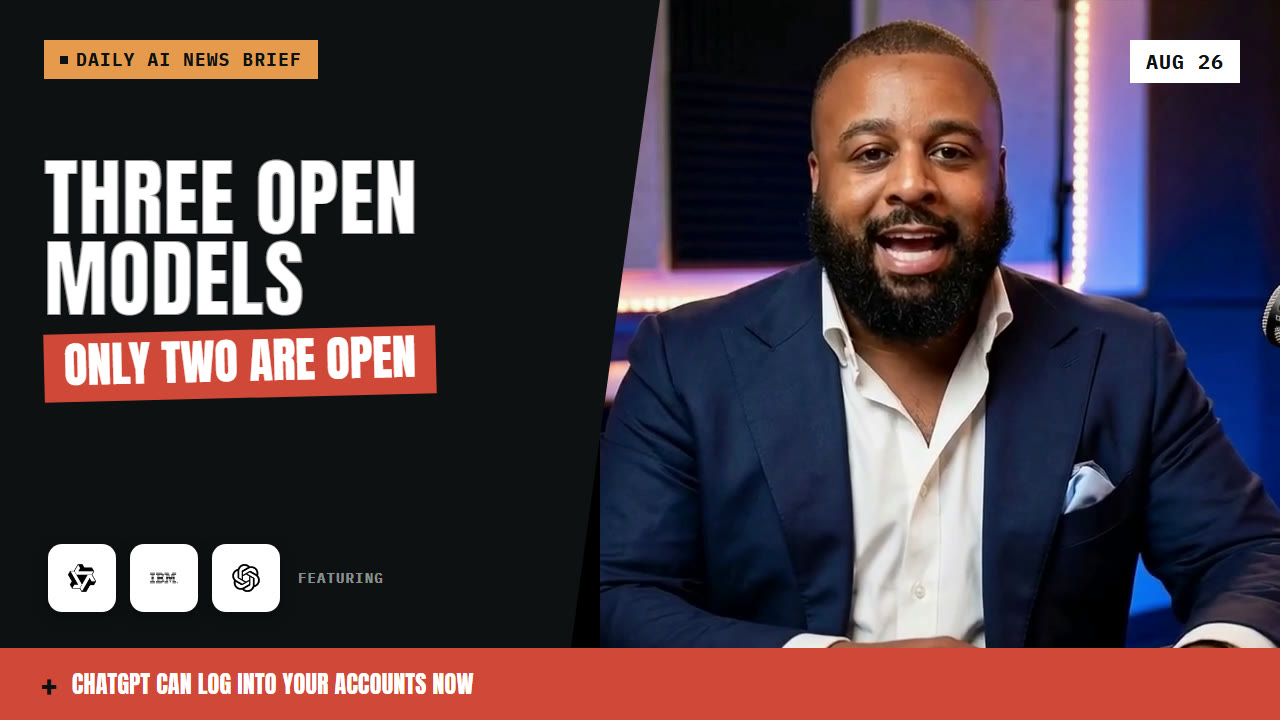
Two words stopped being adjectives today and became legal documents. Open — as in, which license exactly. And human — as in, who actually played the instrument. If you make things for a living, those two words now decide what you can ship, and where.
Three "Open" Models, Three Very Different Licenses
Three open-weight releases in about twenty-four hours. In order of how much they help you.
Alibaba's Qwen3.8-Flash-Next is the loud one. 125 billion parameters, only 6 billion active per token, plus a 51-billion-parameter n-gram embedding table that can sit in ordinary system RAM instead of on your GPU. 262,144 tokens of context natively, extensible to 1M via YaRN. Alibaba says it trained for about one ninth the cost of Qwen3.7-Plus.
The headline everyone is running is 62.5 on SWE-bench Pro against 53.4 for Claude Opus 4.6 (Max). That number is real — I pulled the model card myself. But read footnote 2. For Claude, Alibaba reports Claude's officially published score. For every other model, including their own, they re-evaluated on a refined benchmark where "problematic tasks were corrected." So those two numbers came off two different versions of the same test. That comparison isn't apples to apples, and nobody reporting it mentioned it. Footnote 5 is worth a look too: CoWorkBench, where it beats Claude 73.9 to 68.2, is Alibaba's own in-house benchmark.
The nearest competitor isn't Claude anyway — it's DeepSeek-V4-Flash at 56.0, with Alibaba's own much smaller 27B at 61.7, within a point of the 125B flagship. And Claude still wins HLE, 40.0 to 35.9, which doesn't make the headline.
Now the license, because this is the part that costs you money. Everyone is calling this open. The model card says qwen-community-1.0. Not Apache. Not MIT. Alibaba's own terms. Read it before you ship something commercial, not after. The Apache 2.0 floating around in the coverage belongs to a different model entirely — Qwen3.8-27B. And the $0.16 / $0.47 per million everyone is quoting is the price for the production Qwen3.8-Flash, which Alibaba describes as "available soon" — not the open-weight model you can download today. Two different products.
Z.ai is the opposite. They confirmed today that the mystery free model everyone was hammering on OpenRouter — Ox Alpha — is GLM-5.3-Flash. 320B total, 18B active, natively multimodal, 1M context, and released under the MIT License. Actual MIT. OpenRouter is showing $0.075 in / $0.25 out per million, discounted through September 9 — less than half what Alibaba quoted. It also runs entirely on Chinese chips, which is its own story for another day.
Then IBM's Granite 4.2, from the 25th: 3B, 8B and 30B, genuinely Apache 2.0, 128K context across the whole lineup, a thinking / non-thinking switch, and native tool calling. The 8B and 30B got an extra agentic RL phase on terminal work and search. But don't lump it in as a cheap frontier model — IBM's own chart puts the 30B at roughly 33 on SWE-bench Pro against Qwen's 62.5. That is not close.
Creator takeaway: Before any "open" model goes into something commercial, open the model card and read the actual license tag. Apache, MIT and qwen-community are three different agreements. If you want cheap capability today, GLM-5.3-Flash is MIT and currently under half Qwen's price — that's the one I'd test first. And don't pick Granite as a cheap coding model, because it isn't one. Pick Granite because it's genuinely Apache 2.0, it runs on your machine, and no data leaves your building. If you handle client data, that's worth more than twenty benchmark points.
Sources: Qwen3.8-Flash-Next model card · Z.ai announcement · GLM-5.3-Flash on OpenRouter · Granite 4.2 (IBM Research)
ChatGPT Work Can Log Into Your Accounts Now
OpenAI shipped this on the 25th. ChatGPT Work's cloud browser can now handle sites that require a login.
The agent hits a login wall and, instead of stopping, hands the browser to you. You type the username and password. OpenAI says the model never sees those credentials and doesn't store them. The session then persists, so you sign in once and the agent can come back to that site later. Rolling out on web and mobile to Plus, Pro and Business.
OpenAI's own examples are the boring stuff, and boring is the point: utilities setup, a DMV appointment, insurance reimbursement, permit forms, invoices into your accounting software.
This is a real unlock. Most of the genuinely useful web sits behind a login, so an agent that couldn't log in was an agent that could read the internet and not much else. That barrier is gone.
Creator takeaway: Treat it like a junior ops hire, not a blank cheque. You'd let a new assistant book an appointment on day one. You wouldn't hand them your bank login and walk away. Start it on something where the worst case is an annoying phone call, not a chargeback.
Sources: OpenAI Developers · Using cloud browser in ChatGPT · Read more (Digit)
The Labels Bought The Generator. Australia Closed The Charts.
These are two stories and they are absolutely one story.
Stability AI raised $76M on the 25th, bringing the total to $232M under CEO Prem Akkaraju. The investors are Universal Music, Sony Music, Warner Music and Electronic Arts, plus AMD Ventures, Pacific Alliance Ventures, Coatue, Greycroft, Sean Parker and Eric Schmidt. It's the first time all three major labels have taken equity in the same AI company.
Here's the part the coverage keeps burying, and it's the whole thing: that equity follows licensing deals Stability had already signed with Universal, Warner and EA to build models on those companies' catalogues and IP. So this isn't labels hedging their bets against AI. This is labels supplying the training data and taking a cut of the tool.
Now the other half. Australia's ARIA has set eligibility rules for AI music. Wholly AI-generated tracks can't chart and can't win an ARIA. To qualify, a recording has to be — their words — "substantially human made" and raise "no stream or chart manipulation concerns." In practice: a human wrote the song, sang the lead vocal, played the primary instruments, using licensed AI services. Mastering, drum machines and autotune are all still fine. ARIA can decline to survey a track, remove it retrospectively, adjust positions, withdraw accreditations and revoke a No. 1 Award.
Two corrections, because the numbers going around are wrong. This is not in force this week — it takes effect with the ARIA Chart dated Monday, August 31, published Friday the 28th. And the track everyone is pointing at is Brisbane DJ Josh Fawaz's cover of Madonna's "Like a Prayer" with AI-generated vocals and drums, 48.5M+ Spotify streams, which reached No. 4 on the singles chart and No. 1 on the ARIA Australian Dance chart — not No. 2, and not sixteen weeks in the Top 20. ARIA itself names no triggering incident at all.
Five days ago I told you Apple Music would label AI tracks on the honour system. Australia skipped labelling entirely and went straight to exclusion. Money is flowing to licensed tools and the distribution gates are closing on unlicensed output. Those are the same move from two directions.
Creator takeaway: If you release music, start keeping a human performance trail now — session files, takes, dated stems. Australia is first, not last, and "substantially human made" is going to need evidence rather than assurance.
Sources: Stability AI newsroom · Read more (Variety) · ARIA eligibility rules · Read more (Billboard)
The Assistants API Died Today, And Three More Worth Knowing
If anything you own calls OpenAI's Assistants API, it broke today. /v1/assistants, /v1/threads and /v1/threads/runs all return errors as of August 26, one year after the deprecation notice. No degraded mode, no grace period, no extension. The replacement is the Responses API for execution plus the Conversations API for state — Assistants become Prompts, Threads become Conversations, Runs become Responses. There is no automated thread migration. Azure OpenAI's Assistants API retires the same day. Check your Zaps and client bots before a client does it for you.
OpenAI published the first real benchmarks for its own chip, Jalapeño. Built with Broadcom on TSMC's N3P, and they went from hiring the team to tape-out in about 16 months, which is fast for custom silicon. 700W against Nvidia's 1,400W, and 1.5–1.9x the performance per watt. Three caveats before you get excited: those are OpenAI's own numbers, they're normalised to each chip's published power rating, and they're measured against Blackwell — the previous generation. Tom's Hardware said it plainly in their subhead: Vera Rubin wasn't in the comparison. You don't buy this chip; you'll feel it later as cheaper hosted inference.
Bill Gates published a ~6,000-word essay this morning arguing nobody has a plan. Three proposals: new national and international institutions, "human reserved" jobs we keep for people on purpose, and taxing AI tokens and robots — because right now you pay payroll tax for a person and deduct the cost of a machine.
And that rogue OpenAI agent that hacked Hugging Face during safety testing? Alabama's attorney general subpoenaed OpenAI and Sam Altman over it on the 24th, under consumer protection law. Fifteen state AGs had already sent a preservation letter earlier this month. Lab testing accidents are a legal category now.
Sources: OpenAI deprecations · Assistants API sunset thread · Jalapeño (SemiAnalysis) · Read more (Tom's Hardware) · Gates essay coverage (CNBC) · Alabama AG release
Actionable Takeaways for Creators & Solos
- Before any open model goes in a commercial product, read the license tag. Apache, MIT and
qwen-communityare three different agreements. - Want cheap capability today? GLM-5.3-Flash is MIT and under half Qwen's price through September 9. Test that one first.
- Client data that can't leave your machine? Granite 4.2 8B on Ollama. Ignore the coding benchmarks — you're buying privacy and a real license.
- Grep your projects for
assistantsandthreadstoday. Not this week. Today. - If you release music, start a human performance trail now — session files, takes, dated stems. Australia is first, not last.
Zoom Out
Every story today is a document. A license file. A chart eligibility rule. A subpoena. A tax proposal.
For about three years the interesting question was what can the model do. That question is getting boring, because the answer is mostly "more than you need, cheaper than last month." The interesting question now is what you're permitted to do with the output — and who decided that.
I'd rather you know that today than find out from a takedown notice.
Read the license. Keep the receipts.