I Used ChatGPT + Codex to Plan 30 Days of Content
📓 Download the free 15-page workflow guide — the prompts, worksheets and the full calendar it produced, all copy-paste ready.
Most AI-generated content calendars are useless.
You ask for thirty ideas and it gives you "share a motivational quote," "post behind the scenes," and "tell your audience to believe in themselves." Thank you, robot. My entire content strategy is saved.
That output is not a model failure. It is a briefing failure. With no constraints to aim at, a model fills the space with the safest, most generic thing that technically answers the question — and "give me thirty content ideas" has no constraints in it at all.
So I gave ChatGPT and Codex my actual channel, my actual audience, and my three content pillars, then delegated the research to three lighter agents. Here is what came back, including the part that was uncomfortable.
The problem was never a shortage of ideas
Ideas kept arriving as separate pieces. A news story here. A tutorial idea there. Something about ethical AI that I knew mattered but had never connected to the rest of the channel.
That produces activity. It does not produce a strategy.
The channel is supposed to help creators and solo business owners use AI to buy back time. Three pillars: practical walkthroughs, AI news and announcements, and using AI ethically. But if the actual videos do not reflect that balance, the positioning is just a sentence in my head.
I needed a system that could answer three questions. What have I already been publishing? What is missing? What should I make next, without turning content planning into a second full-time job?
Constraints first, creativity second
The first prompt carried four pieces of context: who I am, who the channel is for, the outcome I want to help people reach, and the three pillars. Then one more line that does most of the work — instructing it to use delegated lighter-model agents for the audit, the research and the calendar strategy.
Notice what is not in that prompt. I never asked for thirty viral ideas. Viral according to what? For which audience? Connected to which business goal? Every one of those questions is answered by a constraint, and if you do not supply them the model has to invent them.
A useful test: if you could hand your prompt to a stranger and they could not tell whose channel it was for, the model cannot either.
Three agents, three boundaries
I used three because I did not want one model trying to research, audit, strategise, and then agree with itself.
- Agent one — the channel audit. Pulled the public upload metadata: titles, formats, upload dates, view counts. Answers what have I actually been publishing?
- Agent two — topic research. Current topics relevant to the audience, prioritising primary sources over whatever somebody posted on social twelve minutes ago. Answers what is worth covering now?
- Agent three — the publishing system. A rhythm sustainable at my stated capacity. Answers what can I actually keep up?
They ran in parallel, which saved time. But the more important effect is that it created separate points of view. The strategy agent did not have to pretend its own research was brilliant, because a different agent did the research.
This is where prompt engineering starts becoming workflow engineering. The value is not one clever prompt. It is dividing the job, giving each agent a boundary, and bringing the results back for review.
The number I did not want to see
At the time of the audit the channel had 22 long-form videos and 4 Shorts. Categorised: 17 news or announcement videos, 4 walkthroughs, and 1 led primarily by the ethics pillar.
That is 77% news.
I knew I had been making a lot of news. I did not realise the channel had become that heavily weighted toward it. That is the actual value of an audit. It is not there to insult your strategy — it is there to show you the strategy your behaviour has already created.
The data turned up something else. A Short titled "An AI Agent Can Now Buy Your Coffee" had 105 public views when the audit ran, more than any long-form upload at the time. That is not enough to declare Shorts the winner; one video is not a strategy. But it is enough evidence to test more of them instead of treating them as an occasional side project.
From a list of content to a content system
The recommended mix moved the channel toward 50% walkthroughs and case studies, 25% news and announcements, 25% ethical AI and trust content.
Those numbers are not a law. They were right for my promise. The point is that the calendar should support the promise rather than repeat the existing imbalance.
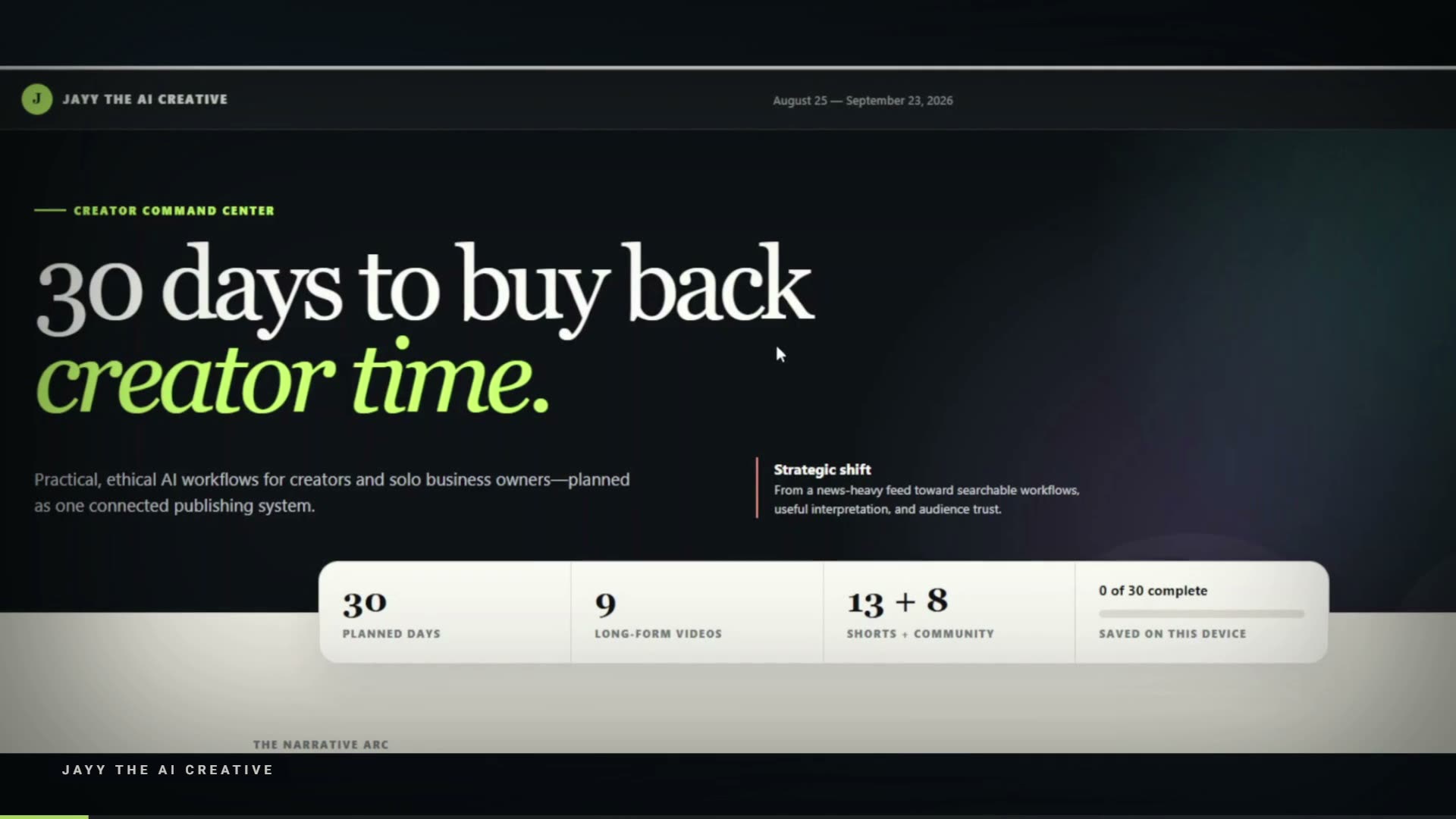
The schedule that came out: nine long-form videos, thirteen Shorts, eight Community posts. Tuesday became the main walkthrough or case-study day. Friday became the flexible news or ethics slot. Shorts and Community posts support the larger videos instead of behaving like unrelated content from a different channel.
One long-form idea now produces a demonstration, a Short, a poll, a checklist and a follow-up question. That is the difference between a list of content and a content system.
Making it something I would actually open
The first output was a detailed Markdown plan and a spreadsheet-ready CSV. Useful — but not something that makes you excited to open it every morning.
So I gave Codex a second task and reused the same delegated agents: one on visual direction, one on accessibility and mobile behaviour, one on the interactions a beginner creator would actually use. Out came a single standalone HTML dashboard — calendar and agenda views, filters, search, a detail window for every idea, links to primary sources, local completion tracking, a mobile layout and print-to-PDF.
Because it is one standalone file, it needs no subscription, no database, and no productivity app asking me to upgrade so I can change the colour of a button.
What still needed a human
The agents work from public data. They could not see inside YouTube Studio, and public views are a signal, not the story. Click-through rate, first-30-second retention, average percentage viewed, returning viewers, subscribers gained — none of that was available to them, and all of it decides whether an idea was actually good.
Time-sensitive topics also expire. A feature changes, pricing moves, or a rollout is not available everywhere by the time you record. Every scheduled news topic in the calendar carries a primary source link for exactly this reason.
And some technically good ideas are still wrong for me.
That is the part people miss when they talk about AI replacing creative work. It can give you more options, help you see patterns, and remove a ridiculous amount of administrative friction. But taste is still a decision. Your audience is still a relationship. Publishing something under your name is still your responsibility.
Do not run this as a thirty-day autopilot
If you copy every title without checking the source, testing the workflow, or adding your own experience, you have not built a content system. You have automated the production of things you do not care about.
The tool exposes the user. A thoughtful creator uses it to become more thoughtful and more consistent. A lazy one uses it to publish generic content faster. AI is not making that choice.
The takeaway
You do not need AI to give you more ideas. You need it to connect your audience, your evidence, your positioning and your available time into a system you can actually execute.
Before you ask any model for content ideas, write down your audience, your promise, your three pillars, and the amount of content you can honestly produce every week.
Give the AI constraints before you ask it for creativity. That one change will improve the calendar more than any magic prompt ever will.
The free guide has the whole workflow, set up to run on your channel rather than mine: the constraint sheet, the master prompt, the three agent briefs, the dashboard prompt, the audit worksheet, a troubleshooting table for when the output comes back wrong, a 30-day scoreboard, and all thirty rows of the calendar this produced as a worked example.
📓 Download the 15-page workflow guide — free, no card, no trial.